Translate

Thursday, May 24, 2012

Fake malarial drugs in Asia and Africa

The results of a study conducted by the Fogarty International Centre at the US National Institute of Health in Bethesda, Maryland, USA about the quality of drugs used to treat malaria have shocked the world. According to this report over 1/3rd of malaria drugs tested from Asia and Africa are found to be fake or faulty.


The findings consisting of drugs sold between 1999 and 2010 in 28 different countries of Asia and Africa, were published in the June 2012 issue of the Lancet Infectious Diseases Journal. The authors write that "the economic incentives for criminals of drug falsification surpass the risks involved in production and sales".


The study was conducted mainly of samples from the southeast Asia and sub Saharan Africa.  Of the 1437 drugs from southeast Asia 36% were fake when tested and Africa had 20% of falsified drugs. Apart from counterfeiting other shortcomings were also found, including poor packaging of the drugs, resale of expired drugs in new packs and ineffective drugs. 46% of drugs in southeast Asia and 36% of sub -Saharan Africa were found to have a poor packaging. these include expired drugs that were repacked. 36% of all the samples did not have enough medication in them to fight malaria as they claimed.


Most of these countries do not have proper guidelines, regulations or laboratories for testing the medicines. The authors claim that of all the106 countries where malaria is prevalent only 3 African nations had labs capable of doing such needed tests. (Remember the controversy here that medicines banned in the west for awful side-effects were being dumped here in India?) They called for more stringent laws to fight this crime against humanity.


Source(s):
 Malariaworld
CBSnews
AllAfrica

Wednesday, May 23, 2012

The Sock Theory


Have you ever stood (or laid down) unprotected in a room full of mosquitoes? Have you ever noticed which part of your body the little vampires found juicy?

I have and it is mostly the legs. I had no idea why that was, though I did have a couple of theories. One is that the mosquitoes targeted any part of the body that was sticking out. Like, if you had curved into a ball and stretched out your arms, the mosquitoes bit more at the arms. The second theory is that the proximity our legs had from mosquito hideouts. Like the underside of the work desk, kitchen counter, bed, bushes in the garden, and such.

Turns out I was wrong.

15 years ago, a Dutch scientist Dr. Bart Knols made an experiment on himself. Standing in a dark room he found that the mosquitoes were more drawn to his legs. (Much like I did. Hell, that makes me a scientist too. Where’s the Nobel Prize dude?)

Dr. Knols found that our legs are four times more attractive to the mosquitoes. So if your legs were uncovered you tend to attract four times more mosquitoes, than you would otherwise. Or if you were wearing your stinking socks that you haven’t washed for, say, a week, you’d be a mosquito super-magnet. (South Chennai desperately needs one) However, this effect seemed to diminish after the legs were washed.


Though the finding did seem significant, there were no takers. That was, until now.

In 2009, a young Tanzanian, Fredros Okumu, the Principal Investigator for the Mosquito Control Project of Ifakara Health Institute, decided to use Dr. Knols’ research for his.  Procuring synthetic versions of chemical that imitate what the humans naturally emit as sweat etc. As part of a series of experiments, Okumu’s team have created a sock trap. Experimenting in real life situations in the villages, they used both such synthetic baits as well as human. The volunteers were made to sleep under mosquito nets in a hut, while the chemical cocktail was placed in another. It was so successful that the mosquitoes were attracted more to the chemicals than the humans. They also found that while the socks worked at close quarters, the chemicals worked at a long range. Okumu is convinced that most of the malarial transmission takes place outdoors, so he hopes that his research could be practically applied to control mosquitoes outdoors.  Though, it would take sometime before Dr.Knols’ and Okumu’s works were extensively used.

[Recently, Okumu’s team got funds from the Bill and Melinda Gates Foundation and Grand Challenges Canada. (BMGF do good work, but guys, technology is not always good. We don’t need bio synthesised mosquitoes that might turn our lives into a nightmare worthy of a sci-fi thriller)]


You can follow Fredros Okumu’s blog at www.malariaworld.org/blogs/okumuf

Thursday, May 17, 2012

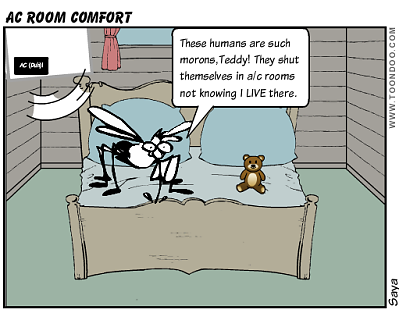
Mosquitoes in aircondition

We had had to argue with a number of people – models, bankers, industry peers, people accompanying customers – just about everyone that mosquitoes are present even in air-conditioned rooms. But most seem sceptical about it, though it is the truth.

They reason that the mosquitoes hate cold. They point out that they are mostly tropical insects. “There aren’t any mosquitoes in hill stations like Ooty and kodaikanal,” one woman said. “They’re too tiny and would freeze in the cold (!!!)”. And the most common argument is that since the a/c rooms are closed there is no way for them to enter.

Before I came into the mosquito net business, I believed like they did. Unfortunately, none of them are right.

It is true that the mosquitoes are tropical and do not like the cold. BUT, that doesn’t mean that they should be strictly tropical and run to the Caribbean when the winter sets in. If it were true, then North America and Europe would not be running with their skirts held high and shrieking.


Researches have found that mosquitoes after mating are capable of waiting out four months of winter to lay eggs after which they die.

About hill stations, I found on the Internet that mosquitoes are usually not found in higher altitudes. But now scientists in Peru have found mosquitoes in higher altitudes. With global warming and warmer winters, we can not anymore expect the mosquitoes to stay at home covering themselves with mufflers, sweaters and shawls. As if that’s not enough our irresponsibility as citizens and tourists have made many popular hill stations look like large dump yards in hilly terrain. Maybe mosquitoes have not yet invaded higher altitudes of Nilgiris but at Kotagiri and lower villages there ARE mosquitoes, trust me. And how stupid should you be to say that mosquitoes would ‘freeze’ in cold weather! What, they unfreeze in winter? If it was possible, frozen Mammoths found in Siberia would be alive now.

Do you know that actually there are more mosquitoes in an air conditioned room than in a room with a fan working? That’s because mosquitoes have difficulty flying in ‘fast moving air’ than in cooler air.

So don’t fling silly excuses at us. Buy a mosquito net, particularly if you’re sleeping in an A/c room.

P.S – Please buy VIEWnet in that case.

P.P.S – We’re quite shameless in marketing our products. J

Monday, April 23, 2012

Choosing the right mosquito net


Mosquito nets are by far the safest and best mosquito protecting equipment as users have confirmed. When we shop for bed nets we are shown different varieties of nets, that makes it hard to decide on the right one. Here are the guidelines to select the right kind of nets.

Like the 4C's for diamonds and 4S for pearls, four factors matter the most while shopping for mosquito nets;
Material
Quality
Shape
Size

Material
Some people are allergic to any fabric other than cotton. For some, nylon gives rashes. Except for such people, any material is suitable for daily use. The truth is, there should be no contact between human skin and the net. Longevity and air flow are the factors to be checked.

Quality
There should not be any ‘hairy’ filaments, which may block airflow and also cause respiratory disorders. Apart from that make sure the net has 150 or 160 HSI (Holes per Square Inch).

Shape
Nets come in fancy shapes that look so good we’d be willing to pay how much ever they cost. But only square or rectangular nets are comfortable as the proximity from the sleeper is farther than with round shaped or other nets.

Size
Size depends on the place it will be used – floor or bed. If you’d be sleeping on a bed you have to measure the bed size for conventional nets.

For  VIEWnet®, measure the size of the mattress.

Insecticide impregnated nets are also being used these days, but they become ineffective within the next six months and have to be treated again. This is not logistically viable. Besides, as seen with chemical repellent brands, we can not be sure how long it takes for the mosquito to develop resistance to the insecticide.  It is up to the buyer to decide upon them.
                            

Thursday, September 29, 2011

Dengue - Facts

With death tolls rising in the sub continent because of dengue, I thought of posting some information about this disease. If I had left out anything, do mail us or write on our FB wall.

Dengue (proper pronounciation 'den-gay') is also called the 'breakbone fever' or the 'dandy fever' as deformation of bones is its most known effect. Dengue is originally and mainly a tropical disease. It was unknown in the western hemisphere till the 1960s when the Caribbean saw deaths in the thousands in an epidemic breakout. Predictably, after that many measure were taken around the world to try prevent/control it.

Dengue is spread by mosquitoes belonging to the genus 'Aedes' (of the order Diptera), especially Aedes albopictus (Asian tiger mosquito) and Aedes aegypti (yellow fever mosquito). Aedes mosquitoes, that prefer biting during the daytime mainly at dawn and in the early evening, are also known to spread Chikungunya. (Chikungunya and Dengue share an important symptom - that of affecting the bones)

This disease is contracted by people with a low level of immunity and hence it is very dangerous to children. Those affected by dengue can have a wide range of illnesses from a seemingly normal viral fever to the fatal hemorrhagic fever.

There are four serotypes of dengue and hence, a person affected once by one serotype could contract this multiple times. As a result of such multiple attacks, the hemorrhagic fever is caused which is almost always fatal to children. Sadly, children are the main victims of dengue fever that is increasingly becoming the most dangerous mosquito borne viral disease to affect the human race and is soon sent to dethrone malaria from that spot it currently occupies.

There is also a belief that, after contracting dengue, if one was infected with the virus, they could develop an immunity that lasts a lifetime. With no scientific proof or confirmation, this might as well be a myth.

The common symptoms of dengue include internal bleeding, bleeding of nose and gums, shock, headache, fever, skin rashes, black stool, joint and muscle pains. If tit does not result in the fatal hemorrhage, it is known to deform and soften bones, thus making victims, especially children weaker.

It is dengue season now in the subcontinent and we have already lost lives unnecessarily. So people please be aware and safe. I'd post the precautions and preventive measures against mosquitoes and the diseases they spread soon. Till then, enjoy the m onsoon without the fear of those pesky vampires. (use VIEWnet).

Ciao.