Translate

Showing posts with label mosquitoes. Show all posts

Tuesday, November 24, 2015

MDB Series - Dengue Part 4

This post is fourth in the series about mosquito borne diseases.

Disclaimer: This post is for information purposes only. This is not written by any medical doctor or government official or anyone related to the worldwide research on mosquito borne diseases. Neither is this a complete information about dengue and should not be relied on for reference. However, we have taken care to refer to reliable sources on the web, the links to which would be provided at the end of the post.


Diagnosis

Clinical diagnosis is usually based on reported symptoms and physical examination. Since dengue has symptoms similar to many viral infections, diagnosis is made when there is fever combined with any two of the following conditions – nauseas and/or vomiting, body pain, rash, low white blood cell count and positive tourniquet test. The tourniquet test is useful in situations where laboratory conditions are not available.

The warning signs occur before the onset of severe dengue. To further determine if it is dengue, the patient’s blood is tested for the presence of the virus and antibodies. Serum samples from the patients’ body are collected for more accurate tests.

ELISA (Enzyme-linked Immuno Sorbent Assay) is a test conducted to find specific anti-dengue antibodies. This is the test conducted by the Government Hospitals in Tamilnadu for diagnosis.

There is a more expensive, complicated but more accurate test called PCR (Polymerase Chain Reaction) which is done to identify genome sequence of the virus from the serum sample or CSF (cerebro spinal fluid) of the patient. This method was introduced in 2012.

However, these tests are useful in diagnosis only when the condition is severe.


Friday, November 13, 2015

MDB Series - Dengue Part 3

This post is third in the series about mosquito borne diseases.

Disclaimer: This post is for information purposes only. This is not written by any medical doctor or government official or anyone related to the worldwide research on mosquito borne diseases. Neither is this a complete information about dengue and should not be relied on for reference. However, we have taken care to refer to reliable sources on the web, the links to which would be provided at the end of the post.


Development

When an infected mosquito bites a human being, the dengue virus enters the blood stream via the mosquito’s saliva. The virus first binds to dendritic cells that have the ability to identify pathogens.  They replicate inside the cells and use cell proteins to multiply. They enter the white blood cells and continue to replicate as the cells move throughout the body through blood. Through the walls of small blood cells, fluid leaks into other body cavities, leading to less blood circulation. This leads to low blood pressure and as consequence there is no sufficient blood flow to vital organs.

When initially the virus attacks a cell, the white blood cells produce a protein called interferon, which cause the fever like symptom. As the blood flow decreases, it leads to dysfunction of bone marrow which further leads to low platelet count. Platelets are necessary to clot blood and arrest flow of bleeding. This is the cause of a severe form of dengue called dengue haemorrhagic fever.

Symptoms

Usually most dengue infected people don’t exhibit many symptoms. Sometimes there are mild generic symptoms like fever. Very few people have severe fever. The incubation period for this disease ranges from 3 to 14 days, but usually it is 4 to 7 days.
The following are the typical symptoms of dengue,
·         Fever
·         Rash and/or increased skin sensitivity
·         Fatigue
·         Headache
·         Nausea
·         Vomiting
·         Cough
·         Sore throat
·         Joint ache
·         Muscle inflammation
·         Nasal stuffiness
·         Swollen lymph nodes
·         Pain behind the eyes
·         Mild bleeding

Dengue per se is not fatal. However, when a high fever is accompanied by any of the above listed symptoms, dengue should be suspected as variations of this disease are fatal.

Variations

There are more severe versions of this disease. Dengue haemorrhagic fever causes bleeding and low levels of blood platelets, resulting in death most often.  Dengue shock syndrome is caused when the blood pressure drops to dangerously low levels. When a patient is infected a second time by dengue, they will have complications associated with the disease. 


Sources: Dengue Virus Net, WHO, WebMD, Wikipedia, Medindia, US National Library of Medicine, Ministry of Health and Family Welfare( Govt of India)

Saturday, October 24, 2015

MDB Series - Dengue Part 2

This post is second in the series about mosquito borne diseases.

Disclaimer: This post is for information purposes only. This is not written by any medical doctor or government official or anyone related to the worldwide research on mosquito borne diseases. Neither is this a complete information about dengue and should not be relied on for reference. However, we have taken care to refer to reliable sources on the web, the links to which would be provided at the end of the post.


Causes and Transmission

Dengue is caused by group of RNA virus called Flavivirus. They are of the same genus as many viruses that cause other dangerous diseases like, Japanese encephalitis, West Nile fever, yellow fever etc. All these viruses are called arbo viruses since they are spread by arthropods (mosquitoes, ticks etc)

There are five strains of this dengue virus, the fifth one announced as recently as 2013. The first four and most commonly known are DENV-1, DENV-2, DENV-3, DENV-4. Their difference is in their antigens. Though humans are the main host for this virus they circulate in other primates as well.

The dengue virus is typically spread by the aedes mosquito, especially Aedes aegypti. This mosquito species is mostly found in the tropical region. They bite during the day, particularly at dawn and dusk. They are sincere in their job of spreading disease, that they work double shift, night and day.

Dengue is spread by other Aedes mosquitoes like Aedes polunesiensis, Aedes albopictus, Aedes scutellaris etc. Of these, due to increased globalisation and industrialisation Aedes albopictus has now spread to temperate regions. It is able to survive in the colder climate of Europe because of higher tolerance to the sub-zero temperatures, hibernation etc.

It is possible to get infected with the first bite itself. As is always the case with mosquito borne diseases, the mosquito spreads dengue from an infected person. In this cases, the disease does not needed to have matured. If a person is infected with the virus still in the initial 2 to 10 day period and a mosquito bites that person, the virus could still be spread to other people. This is because, once the virus bites the infected person it becomes itself infected for life, thus spreading dengue virus as long as it lives. Though the mosquito is infected it is not seriously affected by the virus.

Aedes aegypti mosquito is the primary vector of this disease. A.aegypti and A.albopictus mainly are found in urban habitat where they can easily find humans nearby to feed and breed in stagnant water in artificial storage areas (like water collected in used tyres, broken vessels, open water tanks etc) which are abundant. The female aegypti mosquito feeds on multiple humans per feeding cycle, thus spreading the virus more.

Dengue virus are transmitted via mosquitoes. Person to person transmission is so rare and unusual that it is almost unheard of. However, there have been cases where dengue was transmitted through blood transfusion, organ transplantation, from mother to child during pregnancy or at birth.

Sources: Dengue Virus Net, WHO, WebMD, Wikipedia, Medindia, US National Library of Medicine, Ministry of Health and Family Welfare( Govt of India)

Wednesday, September 23, 2015

MBD Series - Dengue Part 1

We are posting a series about Mosquito-Borne Diseases, along with our other regular articles. This is the first post in that series.

Disclaimer: This post is for information purposes only. This is not written by any medical doctor or government official or anyone related to the worldwide research on mosquito borne diseases. Neither is this a complete information about dengue and should not be relied on for reference. However, we have taken care to refer to reliable sources on the web, the links to which would be provided at the end of the post.

Let's start with,

Dengue

Dengue is a Spanish word, pronounced 'den-gee'. Though its origins are not clear, it's believed to have been from the Swahili phrase ka dinga pepo, that claims the disease to have been caused by evil eye. It has also been called: dandy fever, breakbone fever, break fever etc.

Dengue is the second disease to be identified as caused by virus. The first was the yellow fever.

It is found in the tropical and subtropical regions, especially, 

  • the Indian Subcontinent
  • some parts of the Caribbean
  • some parts of the Central and South Americas
  • sub-Saharan Africa
  • south east Asia
  • the Pacific islands
Dengue has also been identified in other parts of the world where it spread through travellers.

It is spread through mosquitoes of the Aedes genus, Aedes aegypti most known among them. The mosquitoes of this genus are known to bite during the day, dawn and dusk. Dengue is spread via human to human transmission by the females of aedes.

History

The earliest available record of a case that could have been dengue fever was found in the Chinese medical encyclopaedia from the Jin dynasty (265 to 420AD) which referred to a 'water poison' associated with flying insects.

Later, around 15th to 19th centuries AD, Aedes aegypti (the primary vector) spread to other places from Africa due to globalisation and Slave Trade. There have been descriptions about an epidemic in the 17th century.

The most plausible records of dengue epidemics available, however, from 1779 and 1780, when an epidemic swept across Asia, Africa and North America.

In a 1789 report that the US founding father Benjamin Rush, a physician, wrote on the 1780 epidemic of Philadelphia, he used first the term Breakbone fever. Rush however used the more formal Bilious Remitting Fever as the title of his report.

Confirmation of the transmission of dengue by the aedes mosquitoes came in 1906; and in 1907, dengue was the second ever disease know to be caused by a virus. 
Though much research has been going on for centuries, the basic understanding about dengue was completed in early 20th century.

Since the 17th century epidemic, dengue epidemics have been quite few till the Second World War. The spread of dengue since World War II is attributed to ecological disruptions. The same reason is given for the spread of different serotypes of dengue to new areas, and also for the emergence of dengue haemorrhagic fever- a more severe and probably fatal variation of the dengue fever.

Sources: Dengue Virus Net, WHO, WebMD, Wikipedia, Medindia, US National Library of Medicine, Ministry of Health and Family Welfare (Govt of India)

Wednesday, May 08, 2013

Sleep Disorders

"A sleep disorder, or somnipathy, is a medical disorder of the sleep patterns of a person or animal. Some sleep disorders are serious enough to interfere with normal physical, mental and emotional functioning. Polysomnography is a test commonly ordered for some sleep disorders."
That is the definition for sleep disorders given in Wikipedia's Sleep Disorder Page. To put it even simpler than that, sleep disorder is any abnormality in an individual's sleeping patterns. This includes inability to fall asleep, inability to stay asleep, problems during sleep, oversleeping etc.

Though we simply use the phrase 'sleep disorders' as a collective, the disorders themselves are numerous and range from insomnia to narcolepsy to hypopnea to bruxism. Snoring, grinding teeth and shaking legs in sleep are not just some quirkiness of a person, they could be more than that.

Sleep disorders are known to be disastrous for relationships and the patient, even though most of the time they do not know that they have sleep problem. In recent years a new sub discipline called sleep medicine has evolved as part of clinical psychology all over the world. We can say that the awareness has grown in recent years and somnipathy is recognised as a health hazard. However, there are only about less than 200 psychologists in the entire world who specialise in sleep medicine. The internet has lots and lots and lots of information on anything for those who seek, but not all of them are credible.
We have tried to gather authentic information and post it here, so more posts on regarding sleep would follow. We recently realised that we have a few unregistered readers and we welcome any suggestion or information in this topic from them so we can post here. Send us links, articles, your own write-ups, anything. We would verify them and post it here. Send them to viewnetindia@gmail.com with "VIEWnet blog" as the subject. If you don't want your name and email id posted here, please mention that in the email. And if you know any expert in this field, please send us their contact details. We might invite them to co-author the blog.

Next post would simply be a copy-paste of the general sleeping tips from our website, because we are still working on insomnia. Till then, sleep well.

Wednesday, May 23, 2012

The Sock Theory


Have you ever stood (or laid down) unprotected in a room full of mosquitoes? Have you ever noticed which part of your body the little vampires found juicy?

I have and it is mostly the legs. I had no idea why that was, though I did have a couple of theories. One is that the mosquitoes targeted any part of the body that was sticking out. Like, if you had curved into a ball and stretched out your arms, the mosquitoes bit more at the arms. The second theory is that the proximity our legs had from mosquito hideouts. Like the underside of the work desk, kitchen counter, bed, bushes in the garden, and such.

Turns out I was wrong.

15 years ago, a Dutch scientist Dr. Bart Knols made an experiment on himself. Standing in a dark room he found that the mosquitoes were more drawn to his legs. (Much like I did. Hell, that makes me a scientist too. Where’s the Nobel Prize dude?)

Dr. Knols found that our legs are four times more attractive to the mosquitoes. So if your legs were uncovered you tend to attract four times more mosquitoes, than you would otherwise. Or if you were wearing your stinking socks that you haven’t washed for, say, a week, you’d be a mosquito super-magnet. (South Chennai desperately needs one) However, this effect seemed to diminish after the legs were washed.


Though the finding did seem significant, there were no takers. That was, until now.

In 2009, a young Tanzanian, Fredros Okumu, the Principal Investigator for the Mosquito Control Project of Ifakara Health Institute, decided to use Dr. Knols’ research for his.  Procuring synthetic versions of chemical that imitate what the humans naturally emit as sweat etc. As part of a series of experiments, Okumu’s team have created a sock trap. Experimenting in real life situations in the villages, they used both such synthetic baits as well as human. The volunteers were made to sleep under mosquito nets in a hut, while the chemical cocktail was placed in another. It was so successful that the mosquitoes were attracted more to the chemicals than the humans. They also found that while the socks worked at close quarters, the chemicals worked at a long range. Okumu is convinced that most of the malarial transmission takes place outdoors, so he hopes that his research could be practically applied to control mosquitoes outdoors.  Though, it would take sometime before Dr.Knols’ and Okumu’s works were extensively used.

[Recently, Okumu’s team got funds from the Bill and Melinda Gates Foundation and Grand Challenges Canada. (BMGF do good work, but guys, technology is not always good. We don’t need bio synthesised mosquitoes that might turn our lives into a nightmare worthy of a sci-fi thriller)]


You can follow Fredros Okumu’s blog at www.malariaworld.org/blogs/okumuf

Thursday, May 17, 2012

Mosquitoes in aircondition

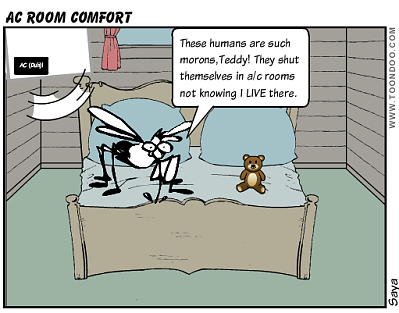
We had had to argue with a number of people – models, bankers, industry peers, people accompanying customers – just about everyone that mosquitoes are present even in air-conditioned rooms. But most seem sceptical about it, though it is the truth.

They reason that the mosquitoes hate cold. They point out that they are mostly tropical insects. “There aren’t any mosquitoes in hill stations like Ooty and kodaikanal,” one woman said. “They’re too tiny and would freeze in the cold (!!!)”. And the most common argument is that since the a/c rooms are closed there is no way for them to enter.

Before I came into the mosquito net business, I believed like they did. Unfortunately, none of them are right.

It is true that the mosquitoes are tropical and do not like the cold. BUT, that doesn’t mean that they should be strictly tropical and run to the Caribbean when the winter sets in. If it were true, then North America and Europe would not be running with their skirts held high and shrieking.


Researches have found that mosquitoes after mating are capable of waiting out four months of winter to lay eggs after which they die.

About hill stations, I found on the Internet that mosquitoes are usually not found in higher altitudes. But now scientists in Peru have found mosquitoes in higher altitudes. With global warming and warmer winters, we can not anymore expect the mosquitoes to stay at home covering themselves with mufflers, sweaters and shawls. As if that’s not enough our irresponsibility as citizens and tourists have made many popular hill stations look like large dump yards in hilly terrain. Maybe mosquitoes have not yet invaded higher altitudes of Nilgiris but at Kotagiri and lower villages there ARE mosquitoes, trust me. And how stupid should you be to say that mosquitoes would ‘freeze’ in cold weather! What, they unfreeze in winter? If it was possible, frozen Mammoths found in Siberia would be alive now.

Do you know that actually there are more mosquitoes in an air conditioned room than in a room with a fan working? That’s because mosquitoes have difficulty flying in ‘fast moving air’ than in cooler air.

So don’t fling silly excuses at us. Buy a mosquito net, particularly if you’re sleeping in an A/c room.

P.S – Please buy VIEWnet in that case.

P.P.S – We’re quite shameless in marketing our products. J

Monday, April 23, 2012

Choosing the right mosquito net


Mosquito nets are by far the safest and best mosquito protecting equipment as users have confirmed. When we shop for bed nets we are shown different varieties of nets, that makes it hard to decide on the right one. Here are the guidelines to select the right kind of nets.

Like the 4C's for diamonds and 4S for pearls, four factors matter the most while shopping for mosquito nets;
Material
Quality
Shape
Size

Material
Some people are allergic to any fabric other than cotton. For some, nylon gives rashes. Except for such people, any material is suitable for daily use. The truth is, there should be no contact between human skin and the net. Longevity and air flow are the factors to be checked.

Quality
There should not be any ‘hairy’ filaments, which may block airflow and also cause respiratory disorders. Apart from that make sure the net has 150 or 160 HSI (Holes per Square Inch).

Shape
Nets come in fancy shapes that look so good we’d be willing to pay how much ever they cost. But only square or rectangular nets are comfortable as the proximity from the sleeper is farther than with round shaped or other nets.

Size
Size depends on the place it will be used – floor or bed. If you’d be sleeping on a bed you have to measure the bed size for conventional nets.

For  VIEWnet®, measure the size of the mattress.

Insecticide impregnated nets are also being used these days, but they become ineffective within the next six months and have to be treated again. This is not logistically viable. Besides, as seen with chemical repellent brands, we can not be sure how long it takes for the mosquito to develop resistance to the insecticide.  It is up to the buyer to decide upon them.
                            

Thursday, September 29, 2011

Dengue - Facts

With death tolls rising in the sub continent because of dengue, I thought of posting some information about this disease. If I had left out anything, do mail us or write on our FB wall.

Dengue (proper pronounciation 'den-gay') is also called the 'breakbone fever' or the 'dandy fever' as deformation of bones is its most known effect. Dengue is originally and mainly a tropical disease. It was unknown in the western hemisphere till the 1960s when the Caribbean saw deaths in the thousands in an epidemic breakout. Predictably, after that many measure were taken around the world to try prevent/control it.

Dengue is spread by mosquitoes belonging to the genus 'Aedes' (of the order Diptera), especially Aedes albopictus (Asian tiger mosquito) and Aedes aegypti (yellow fever mosquito). Aedes mosquitoes, that prefer biting during the daytime mainly at dawn and in the early evening, are also known to spread Chikungunya. (Chikungunya and Dengue share an important symptom - that of affecting the bones)

This disease is contracted by people with a low level of immunity and hence it is very dangerous to children. Those affected by dengue can have a wide range of illnesses from a seemingly normal viral fever to the fatal hemorrhagic fever.

There are four serotypes of dengue and hence, a person affected once by one serotype could contract this multiple times. As a result of such multiple attacks, the hemorrhagic fever is caused which is almost always fatal to children. Sadly, children are the main victims of dengue fever that is increasingly becoming the most dangerous mosquito borne viral disease to affect the human race and is soon sent to dethrone malaria from that spot it currently occupies.

There is also a belief that, after contracting dengue, if one was infected with the virus, they could develop an immunity that lasts a lifetime. With no scientific proof or confirmation, this might as well be a myth.

The common symptoms of dengue include internal bleeding, bleeding of nose and gums, shock, headache, fever, skin rashes, black stool, joint and muscle pains. If tit does not result in the fatal hemorrhage, it is known to deform and soften bones, thus making victims, especially children weaker.

It is dengue season now in the subcontinent and we have already lost lives unnecessarily. So people please be aware and safe. I'd post the precautions and preventive measures against mosquitoes and the diseases they spread soon. Till then, enjoy the m onsoon without the fear of those pesky vampires. (use VIEWnet).

Ciao.

Thursday, September 15, 2011

Mosquitoes disappearing

On the last week of August, a news about the mysterious disappearance of mosquitoes was doing the rounds. Researchers had found that the number of mosquitoes especially those that spread malaria are hard to find in African nations, especially in and around countries like Tanzania, Angola etc.
But this news is NOT heartening as there are disputes about this claim and also there are differences of opinion about the reason for this 'disappearances'. The common perception is that the use of mosquitoes, both insecticide treated and otherwise, vaccinations and other such precautionary and prohibitory methods are finally paying of. Though this seems only logical the truth is such mass disappearance suddenly is not...practical. 
In Africa, like in other places around the world, the weather has kind of become freaky. yes, its the climate change thing. Now mosquitoes, all they do in their time is, eat, mate, bite us, lay egg, repeat this cycle as many times as they could in their lifetime and then die. The most important thing 'laying eggs' is kind of like the only reason they live for. Different species of mosquitoes have different needs and preferences when it comes to this. And being one of the most adaptable life forms, they've evolved so much that they could wait ALL winter with eggs in their bellies, lay eggs when the conditions favour them and then die. So with the climatic conditions bleak in Africa, I'd say they are bidding their time before they come back soon stronger than before. The problem here really is, as they are resistant to the insecticides (contrary to the claims of all manufacturers), we'd be poisoning ourselves more and more to stop them while they'd happily dodge our 'aims' and suck on.

Wednesday, April 20, 2011

4th World Malaria Day

WHO instituted the World Malaria Day in 2007 to spread awareness about Malaria that kills approx. 1 million people around the world every year. This year the 4th world malaria day falls on 25th April 2011, Monday. VIEW Consumer Products are conducting an awareness program on malaria and mosquitoes titled "Mosquito Menace, Malaria and the Myths" on 24th April Sunday at Fortel, Egmore from 5.00 onwards.

Dr. M.B. Nirmal, Founder - ExNoRa International, is the Chief Guest. He would be flagging off an awareness vehicle that would do the rounds in Chennai for two weeks. In the main event, he would be releasing a complimentary book on Malaria and mosquitoes.

This event includes awareness speeches, interactive sessions and dinner.

Interested people would be sent the book which is free of cost, if they write to us or email us with their full postal address.

All are welcome.

Event info in short:
Mosquito Menace, Malaria and the Myths
24 April 2011 Monday
5.00 p.m. onwards,
Fortel, Egmore. (near Egmore station, opp to CMDA)