Translate

Showing posts with label malaria. Show all posts

Wednesday, May 08, 2013

Sleep Disorders

"sleep disorder, or somnipathy, is a medical disorder of the sleep patterns of a person or animal. Some sleep disorders are serious enough to interfere with normal physical, mental and emotional functioning. Polysomnography is a test commonly ordered for some sleep disorders."
That is the definition for sleep disorders given in Wikipedia's Sleep Disorder Page. To put it even simpler than that, sleep disorder is any abnormality in an individual's sleeping patterns. This includes inability to fall asleep, inability to stay asleep, problems during sleep, oversleeping etc.

Though we simply use the phrase 'sleep disorders' as a collective, the disorders themselves are numerous and range from insomnia to narcolepsy to hypopnea to bruxism. Snoring, grinding teeth and shaking legs in sleep are not just some quirkiness of a person, they could be more than that.

Sleep disorders are known to be disastrous for relationships and the patient, even though most of the time they do not know that they have sleep problem. In recent years a new sub discipline called sleep medicine has evolved as part of clinical psychology all over the world. We can say that the awareness has grown in recent years and somnipathy is recognised as a health hazard. However, there are only about less than 200 psychologists in the entire world who specialise in sleep medicine. The internet has lots and lots and lots of information on anything for those who seek, but not all of them are credible.
We have tried to gather authentic information and post it here, so more posts on regarding sleep would follow. We recently realised that we have a few unregistered readers and we welcome any suggestion or information in this topic from them so we can post here. Send us links, articles, your own write-ups, anything. We would verify them and post it here. Send them to viewnetindia@gmail.com with "VIEWnet blog" as the subject. If you don't want your name and email id posted here, please mention that in the email. And if you know any expert in this field, please send us their contact details. We might invite them to co-author the blog.

Next post would simply be a copy-paste of the general sleeping tips from our website, because we are still working on insomnia. Till then, sleep well.

Thursday, May 24, 2012

Fake malarial drugs in Asia and Africa

The results of a study conducted by the Fogarty International Centre at the US National Institute of Health in Bethesda, Maryland, USA about the quality of drugs used to treat malaria have shocked the world. According to this report over 1/3rd of malaria drugs tested from Asia and Africa are found to be fake or faulty.


The findings consisting of drugs sold between 1999 and 2010 in 28 different countries of Asia and Africa, were published in the June 2012 issue of the Lancet Infectious Diseases Journal. The authors write that "the economic incentives for criminals of drug falsification surpass the risks involved in production and sales".


The study was conducted mainly of samples from the southeast Asia and sub Saharan Africa.  Of the 1437 drugs from southeast Asia 36% were fake when tested and Africa had 20% of falsified drugs. Apart from counterfeiting other shortcomings were also found, including poor packaging of the drugs, resale of expired drugs in new packs and ineffective drugs. 46% of drugs in southeast Asia and 36% of sub -Saharan Africa were found to have a poor packaging. these include expired drugs that were repacked. 36% of all the samples did not have enough medication in them to fight malaria as they claimed.


Most of these countries do not have proper guidelines, regulations or laboratories for testing the medicines. The authors claim that of all the106 countries where malaria is prevalent only 3 African nations had labs capable of doing such needed tests. (Remember the controversy here that medicines banned in the west for awful side-effects were being dumped here in India?) They called for more stringent laws to fight this crime against humanity.


Source(s):
 Malariaworld
CBSnews
AllAfrica

Thursday, May 17, 2012

Mosquitoes in aircondition

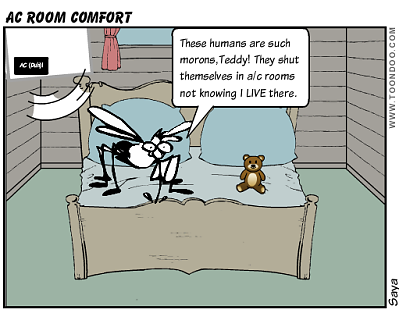
We had had to argue with a number of people – models, bankers, industry peers, people accompanying customers – just about everyone that mosquitoes are present even in air-conditioned rooms. But most seem sceptical about it, though it is the truth.

They reason that the mosquitoes hate cold. They point out that they are mostly tropical insects. “There aren’t any mosquitoes in hill stations like Ooty and kodaikanal,” one woman said. “They’re too tiny and would freeze in the cold (!!!)”. And the most common argument is that since the a/c rooms are closed there is no way for them to enter.

Before I came into the mosquito net business, I believed like they did. Unfortunately, none of them are right.

It is true that the mosquitoes are tropical and do not like the cold. BUT, that doesn’t mean that they should be strictly tropical and run to the Caribbean when the winter sets in. If it were true, then North America and Europe would not be running with their skirts held high and shrieking.


Researches have found that mosquitoes after mating are capable of waiting out four months of winter to lay eggs after which they die.

About hill stations, I found on the Internet that mosquitoes are usually not found in higher altitudes. But now scientists in Peru have found mosquitoes in higher altitudes. With global warming and warmer winters, we can not anymore expect the mosquitoes to stay at home covering themselves with mufflers, sweaters and shawls. As if that’s not enough our irresponsibility as citizens and tourists have made many popular hill stations look like large dump yards in hilly terrain. Maybe mosquitoes have not yet invaded higher altitudes of Nilgiris but at Kotagiri and lower villages there ARE mosquitoes, trust me. And how stupid should you be to say that mosquitoes would ‘freeze’ in cold weather! What, they unfreeze in winter? If it was possible, frozen Mammoths found in Siberia would be alive now.

Do you know that actually there are more mosquitoes in an air conditioned room than in a room with a fan working? That’s because mosquitoes have difficulty flying in ‘fast moving air’ than in cooler air.

So don’t fling silly excuses at us. Buy a mosquito net, particularly if you’re sleeping in an A/c room.

P.S – Please buy VIEWnet in that case.

P.P.S – We’re quite shameless in marketing our products. J

Thursday, September 15, 2011

Mosquitoes disappearing

On the last week of August, a news about the mysterious disappearance of mosquitoes was doing the rounds. Researchers had found that the number of mosquitoes especially those that spread malaria are hard to find in African nations, especially in and around countries like Tanzania, Angola etc.
But this news is NOT heartening as there are disputes about this claim and also there are differences of opinion about the reason for this 'disappearances'. The common perception is that the use of mosquitoes, both insecticide treated and otherwise, vaccinations and other such precautionary and prohibitory methods are finally paying of. Though this seems only logical the truth is such mass disappearance suddenly is not...practical. 
In Africa, like in other places around the world, the weather has kind of become freaky. yes, its the climate change thing. Now mosquitoes, all they do in their time is, eat, mate, bite us, lay egg, repeat this cycle as many times as they could in their lifetime and then die. The most important thing 'laying eggs' is kind of like the only reason they live for. Different species of mosquitoes have different needs and preferences when it comes to this. And being one of the most adaptable life forms, they've evolved so much that they could wait ALL winter with eggs in their bellies, lay eggs when the conditions favour them and then die. So with the climatic conditions bleak in Africa, I'd say they are bidding their time before they come back soon stronger than before. The problem here really is, as they are resistant to the insecticides (contrary to the claims of all manufacturers), we'd be poisoning ourselves more and more to stop them while they'd happily dodge our 'aims' and suck on.

Wednesday, April 20, 2011

4th World Malaria Day

WHO instituted the World Malaria Day in 2007 to spread awareness about Malaria that kills approx. 1 million people around the world every year. This year the 4th world malaria day falls on 25th April 2011, Monday. VIEW Consumer Products are conducting an awareness program on malaria and mosquitoes titled "Mosquito Menace, Malaria and the Myths" on 24th April Sunday at Fortel, Egmore from 5.00 onwards.

Dr. M.B. Nirmal, Founder - ExNoRa International, is the Chief Guest. He would be flagging off an awareness vehicle that would do the rounds in Chennai for two weeks. In the main event, he would be releasing a complimentary book on Malaria and mosquitoes.

This event includes awareness speeches, interactive sessions and dinner.

Interested people would be sent the book which is free of cost, if they write to us or email us with their full postal address.

All are welcome.

Event info in short:
Mosquito Menace, Malaria and the Myths
24 April 2011 Monday
5.00 p.m. onwards,
Fortel, Egmore. (near Egmore station, opp to CMDA)